My TOP books
My TOP books
Recently, while reading a book, I stumbled upon a list of works the author considered landmarks for themselves. This got me thinking: what books became the most important for me? I realized I’d never explicitly written about this, even though I’ve been sharing summaries and thoughts on individual works in blogs since 2006.
⏩ Also, on my website https://danvoronov.com/studied/, there’s a section where I periodically update my ratings of what I’ve read and try to recall all the books I’ve ever read or left unfinished. I haven’t added all the books from last year (2024) yet, but overall, for all years, this is the TOP:
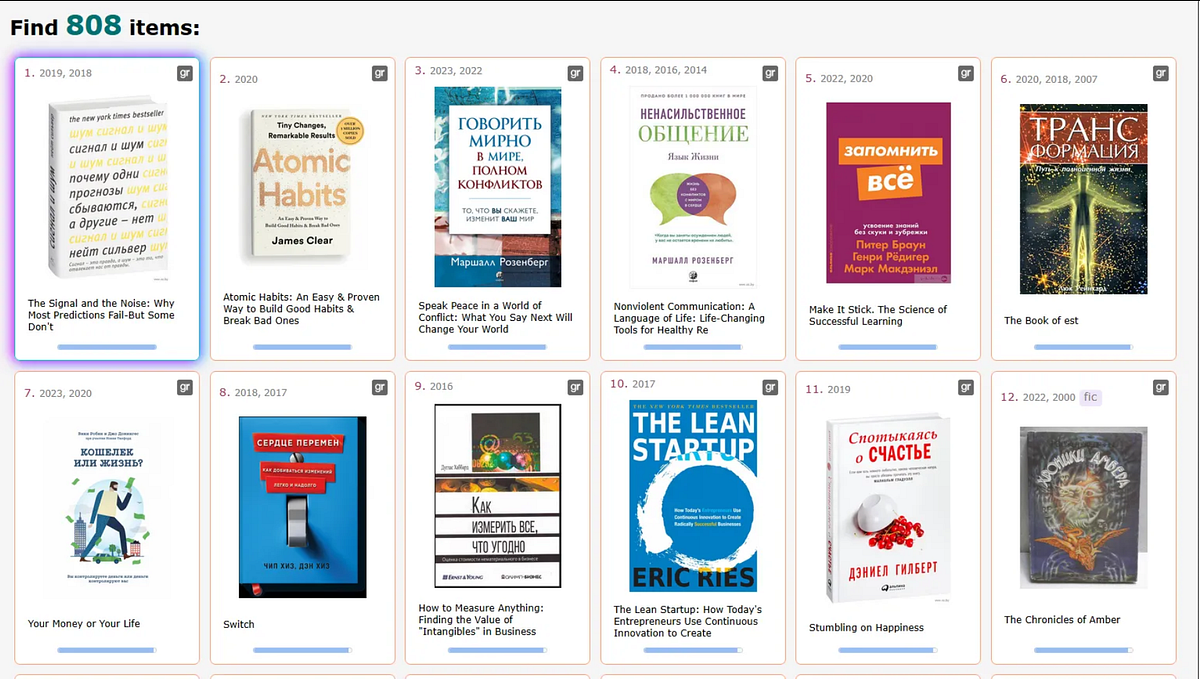
As you can see, the only fiction book here is “The Chronicles of Amber.” Overall, only about 20% of all the books I’ve read are fiction.
It’s pretty clear what “Atomic Habits” and Rosenberg’s NVC (Nonviolent Communication) are all about. “Make It Stick” pairs well with Dean’s “How We Learn: Why Brains Learn Better Than Any Machine . . . for Now.”
To date, I’ve read about 750 books in my life. I’ll tell you why these four books (that’s 0.5% of the total) were so important to me:
- The Signal and the Noise by Nate Silver [2012]
- The Book of est by Luke Rhinehart [1976]
- Switch by Chip Heath, Dan Heath [2010]
- The Chronicles of Amber by Roger Zelazny [1970]
Let’s dive in.
“The Chronicles of Amber” series, 1970–78, 1985–1991
The Chronicles of Amber is a series of fantasy novels by American writer Roger Zelazny. The main series consists of two…en.wikipedia.org
📅 Approximate reading year: 2000 / 16 years old, i.e., around the time I was finishing school.

I specifically searched to put the exact cover I had on my website; it’s the 1994 edition. My parents most likely bought me the book at “Tekhnicheskaya Kniga” (Technical Book store), because we still lived near this shop back in the USSR days and would occasionally pop in during walks (until they started selling fur coats there after the 90s) — then it sat there for about 5 years until I decided to read it on a train ride to the village.
Then I intentionally sought out the rest of the series. It’s divided into two volumes of five parts each; in the first volume, Corwin is the main character, and in the second, it’s his son Merlin. Back then, I couldn’t read it in the original, so I read it in Russian. A couple of years ago, I started rereading it in English.
🤔 WHY THIS BOOK? This was the first serious fiction book (series) I read. Before it, of course, I’d read many fairy tales, children’s books, and kids’ detective stories which were super popular in the 90s, but this was something else entirely.
I hadn’t heard of Harry Potter back then (the texts started coming out in 1997–98). For some reason, I remained oblivious to these books for a very long time and only paid attention when the movie came out — but I still didn’t read them, although it later became clear that for the next generation, it was a life-shaping series. Meanwhile, my classmates were reading Tolkien. For some reason, I wasn’t interested in that at all back then either. They even dressed up and hit each other with swords. I only read Tolkien when the movies came out. These huge and very popular series passed me by as a teenager, but “The Chronicles of Amber” found its way to me by chance. Maybe if it had been “The Lord of the Rings” or “Harry Potter” or “Haunting Adeline,” I would have grown up to be a different person =)
My first foray into speculative fiction (though it’s a blend of fantasy, noir, mythology, and science fiction) was the world of The Chronicles of Amber. I loved the characters and their attire, the colors, the princes/princesses traveling between worlds (Shadows). Their complex relationships, friendships and feuds, intrigues, and multi-layered plots — it was all incredibly dynamic and captivating.
I don’t even remember the full extent of my impressions, but the book definitely became a turning point for me and my love for reading.
In the first pentalogy, the main character, Corwin, starts with amnesia, and I gradually learn his past along with him — sure, it’s a bit of a trope, but I remind you, this was the first such book I read. There’s the primal world of Order (Amber) and passages between worlds — I really liked the concept of the Pattern (the Labyrinth) that one must walk to travel, and that 🛑 you can’t go back. I’ve thought about this many times in my life.
And the Cards of Chaos! I dreamed so much of communicating “through cards,” and when Skype appeared, I realized: there it is, they implemented this idea from the book. Of course, in the book, you could also “pull” each other through the cards, creating portals. We haven’t gotten there yet, but maybe “AI will help us,” and human teleportation will work in my lifetime.
Besides, the series is unfinished. I read everything I could find, even some drafts and fragments, but the plot has no end. I spent my first internet sessions and my first internet access cards specifically to find any information about what happened next, only to find fan sites and fan fiction.
Back then, as a teenager, I didn’t delve too deeply into the philosophy and metaphors of the work, of course. The book astounded my imagination, planted dreams, and became a benchmark for all subsequent fiction books.
📚 Then I read Sapkowski’s “Witcher” series, then Lukyanenko’s “Night Watch” series, and much more while I was doing my first degree at KPI (Kyiv Polytechnic Institute). Other important works of fiction for me were “Ender’s Game,” when I was studying at the “Chornyi Kvadrat” (Black Square) theatre studio, and Heinlein’s “Stranger in a Strange Land,” when I was organizing discussions on polyamory.
“Switch: How to Change Things When Change Is Hard,” 2010
From Wikipedia, the free encyclopedia Dan Heath is an American bestselling author, speaker and fellow at Duke…en.wikipedia.org
Read 3,491 reviews from the world's largest community for readers. Why is it so hard to make lasting changes in our…www.goodreads.com
📅 Reading years: 2017, 2018 / 34 years old.
🤔 WHY THIS BOOK? After my math degree, I pursued a second degree in psychology from 2008–2011, where I became particularly interested in unlocking creative and personal potential in people. Around the same time, coaching started to arrive in Kyiv, and I actively studied and practiced it too, I was part of the scene. I enjoyed working with individuals and groups, but I always wanted more, some kind of framework for changing communities, companies, countries.
That’s how I got interested in the books by brothers Chip and Dan Heath, especially “The Power of Moments,” which I read a bit later. Their books are very practical. And I read “Switch” earlier; it’s packed with usefulness about organizing change in people.
They draw on research from psychology, sociology, economics, and other behavioral sciences. They don’t just voice opinions; they show why certain approaches work, backing it up with data. The book demystifies the change process and offers an alternative to the common belief that change requires budgets, immense willpower, or deep problem analysis.

They simplified the change template to the Rider and the Elephant (similar to Kahneman’s fast and slow thinking), making it the central metaphor of the book. The Rider’s job is to point in a clear direction, break down big goals into small ones, and find bright spots (examples of success). The Elephant’s job is to shrink the change (so it’s not daunting) and create a sense of identity (people do what aligns with their self-image). And then, overall, to Shape the Path: change the environment to make desired behaviors easier and undesired ones harder; build habits; rally the herd.
Then they break down specific case studies of how people intervened in large systems (direct the rider, motivate the elephant, shape the path of change) where others live and work, and changed them for the better. Sometimes I had this “wow” feeling that it’s possible, and I want to do that too. Change systems.
This book is important to me because, from my experience, individual change-coaching-therapy for the better often works short-term like “swimming against the current,” and people will endlessly revert if the surrounding systems are unhealthy and hinder rather than help them live, rejoice, connect, play, create, etc. The main solution is to change not only people but also the environment and cultures.
For this, I attended various urban workshops, learned how Berlin excels at transforming third places, and we did interventions in Kyiv, though I can’t say they were wildly successful. I’d love to “fix systems” at the level of large organizations, but for now, both reading about it and what’s accessible to me still feels like science fiction. But it was very encouraging that they succeeded, and each case study fills me with optimism.
📚 There’s also a lot about the need for systemic change in “Stolen Focus” — you can’t solve the problem of large companies turning the internet into a machine that degrades mental health and attention by meditating; so we need to get together and, for example, establish public ownership or impose regulatory policies on them.
📚 Similar books I’ve read at the habit level include “Atomic Habits” by an American PE teacher who decided to create a program for changing habits. I rated it higher because it’s one of the clearest, most practical books I’ve read, and I’m not detailing it here only because it was published in such huge print runs that everyone should have two copies by now. At the company level, there’s “Reinventing Organizations” about organizations with peer-to-peer management principles. Goldratt’s “The Goal” about the weakest link also fits here.
“The Book of est,” 1976
The Book of est is a fictional account of the training created by Werner Erhard, ( est), or Erhard Seminars Training…en.wikipedia.org
📅 Reading years: Since 2007 / 23 years old. And every couple of years, sometimes more often.
📚 When I was studying psychology, I used to browse the koob.ru online library (it still exists), looking for something obscure and cool. That’s how I found the book “Future Time Perspective and Motivation,” which clarifies a lot in psychology.
And that’s how I found “The Book of est” (originally “Трансформация” — Transformation in the Russian version I read). This book has an amazing quality for me: every time I read it, I perceive it differently, and it helps me in life! 🥰
It’s a work of fiction, written as a novel, that tries to convey the atmosphere and ideas of the EST (Erhard Seminars Training) through plot and dialogue, although it’s not an official description.
More precisely, the book has three parts — the beginning and end explain what EST is, its theoretical foundations, and how it was conceived. The middle is a novel-training, a reconstruction of a participant’s experience in the very famous and, in its time, influential personal growth program created by Werner Erhard in the 1970s.
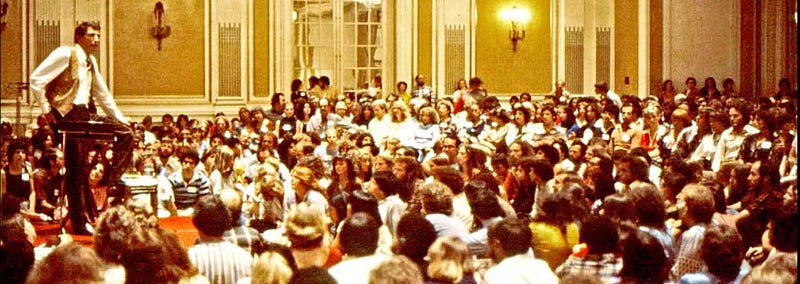
🤔 WHY THIS BOOK? One could say that in the history of psychology, this was the first personal growth training, and everything that came after (including Tony Robbins’ program, shown in the film “I Am Not Your Guru”) grew out of it and its format. Both in the USA and later in other countries. Of course, when big money got involved, everyone fell out, sued each other, different trainers went their own way, etc., but the book itself describes that golden period when the program was at its peak.
Reading it and “being there” each time makes me think about where I am and experience myself and the world differently. So, the training itself is gone, but its echoes still work and help me.
Werner managed to collect and compile the entire essence of the human potential movement of the 1970s — various philosophical, psychological, and spiritual disciplines that existed during that peak period of liberal US history (Hippies, Eastern cultures, sexual revolution). And the Church of Scientology repeatedly accused Erhard of stealing ideas.
“EST bears little resemblance to Dianetics or Scientology; however, EST is a mixture of philosophical bits and pieces selected from systems of existential philosophy, motivational psychology, Maxwell Maltz’s psycho-cybernetics, Zen Buddhism, Alan Watts, Freud, Abraham Maslow, L. Ron Hubbard, Hinduism, Dale Carnegie, Norman Vincent Peale, P.T. Barnum, and whatever else Werner’s intuition suggested would work in the burgeoning Human Potential market.”
The training explores how our past decisions, “unfinished business,” and the “stories” we tell ourselves about the past shape our present and future.
I later learned that many books were written about the EST program, but since I read this one when the wave had significantly receded, even the clones that existed in Kyiv were already declining, so my only material was this book, and it was precisely its first-person fictional part that captivated me.
Some EST concepts, like “what is, is,” and the call to “stop thinking and let go,” are compared to Zen Buddhist ideas. The program teaches to distinguish experience from our interpretation of it. It’s constantly said that the training is an EXPERIENCE; its logical constructs are needed to provoke them. If you want, you can find tons of contradictions in everything the trainer says. Because EST is not about understanding, nor about logic, scientific rigor, etc.
I think I can now predict what will be on the next pages of the book and quote phrases. I even thought about making flashcards to memorize the entire text, like people used to memorize the Bible. But I haven’t done it yet.
📚 Similar coaching books I’ve read that are like a training are “Refuse to Choose,” Cameron’s “The Artist’s Way,” and “Essentialism” by Greg McKeown, but they are not fictional representations, rather collections of exercises to do. It’s good that I went through “The Artist’s Way” for 12 weeks online with a group, but still, these programs feel just like programs.
I don’t know when EST will stop working for me, but I know I’ll continue rereading it. Every time I think I’ve understood it and that “it’s about this,” and then I see it differently, and differently, and differently.
“The Signal and the Noise,” 2012
The Signal and the Noise: Why So Many Predictions Fail - but Some Don't is a 2012 book by Nate Silver detailing the art…en.wikipedia.org
📅 Reading year: 2018 / 34 years old.
I was gifted the paper English version for my 40th birthday; now it sits on my shelf and makes me very happy.

I found this book in the corner of a shelf in a small bookstore near my home. The title intrigued me; I flipped through it, and it seemed to be exactly what I had been missing all my years in my first degree in Math, specializing in Probability Theory, as, from my memory, we only had one example in 6 years, and that was about wheat yields.
🤔 WHY THIS BOOK? Honestly, I don’t know why this book is at the top of my rating. There doesn’t seem to be anything particularly special about it. Nate discusses several different subject areas (meteorology, finance, politics, sports, seismology, etc.) where we try to predict the future and constantly fail at it.
He also adds cognitive psychology, showing that people are very, very, very, very bad at intuitively assessing probability (which is what betting thrives on). How easily news manipulates our constructed understanding of reality. That most experts (especially in media, politics, economics), having studied for so long, have long “died” in their expertise and are thinking with concepts the world has long since moved on from, and their forecasts are worthless.

It’s a popular science book about (Bayesian) probability. More popular and worldview-shaping than scientific or a textbook. What I liked about it was the wide variety of topics raised where understanding probability theory can help identify patterns. It shows how principles of good and bad forecasting manifest in practice, how easy it is to make mistakes or deliberately manipulate statistics on top of raw data.
He describes prediction markets and, of course, poker very coolly. I liked that he presented climate skeptics as a continuum of different opinions. The central idea is the importance of acknowledging uncertainty and the need to constantly update one’s beliefs and recalculate probabilities.
Cool reflections on whether it’s even possible to describe reality with any precision and approximation. A cool idea that we need the accuracy of describing the world specifically for a particular situation. Most people don’t even think that what they know is (in)correct with a certain probability. Moreover, it’s variable by context / over time — and they refer to scientists as authoritative gods who have “uncovered truths.” A lot of (bad) science has emerged from carelessly interpreted data collection results and faith in authorities, and (bad) journalism has further simplified, distorted, and spread it through the media.
He also describes overfitting well, which I had learned about before this from a course on data science. When a model fits the training data too well and performs poorly on new data — when a person interprets reality only based on the data they have.
I think what fascinates me are precisely those people who live by the principle of “probability, not certainty,” who see the instability and volatility of the world (the nature of reality) more clearly through a probabilistic approach and react quickly to where they should best move. They find that small “signal” part in information that matters. They are a little more accurate than others about what will happen soon. They don’t get stuck in any ideologies or ideas but constantly update their understanding of the world based on new data and its correct assessment.
The importance of this book for me is that it describes important mathematical theories without the math and in the context of the real world and real situations. I want to be able to apply them.
📚 The author himself became known in the US for creating methods for predicting baseball results and later election outcomes. Similar books are “How to Measure Anything” in terms of measuring, and “Metathinking / Know Thyself” in terms of managing confidence.
Bonus: “Punished by Rewards,” 1993
Alfie Kohn (born October 15, 1957) is an American author and lecturer in the areas of education, parenting, and human…en.wikipedia.org
I read this book last spring and haven’t yet decided how much it’s influencing my life. The author’s philosophical position is that any external motivation is inherently inferior to internal motivation.
That is, to the proven fact that punishments don’t work at all to change people’s behavior, he adds the idea that rewards don’t either. In such systems, you constantly have to “stand over someone’s shoulder” to get them to do anything.
Through this lens, one can view the entire organization of our society, its reliance on money to compel work. Alfie Kohn advocates that instead of designing “carrots and sticks,” we should focus on designing a stimulating environment in which it’s easiest for each person to discover their internal motives and act according to them. This is how Montessori schools work for children, and it can be expanded.
Conclusion
Rereading my thoughts on these books, I realize that what unites them is my aspiration not just to read, but for a deeper understanding of myself and the world, and to search for effective ways to make life — my own and that of those around me — better. Of course, I don’t stop reading and regularly browse Goodreads, optimistic about finding books that will overshadow these. 😉
And what books have become landmarks for you? What works made you look at the world differently or pushed you towards important changes? I’d be glad if you wrote such a list; you can share it with me too.